B.Sc. in Dentistry
Program Profile
The Bachelor of Dental Surgery (BDS) program is a professionally oriented undergraduate program designed to prepare students for a career in general dentistry.
The program provides a strong foundation in biomedical sciences, preclinical and clinical dental skills, and professional ethics. Emphasis is placed on evidence-based practice, critical thinking, and patient-centered care.
Students receive hands-on training through simulated and real clinical settings, enabling them to diagnose, prevent, and treat oral diseases.
Upon graduation, students are qualified to enter clinical practice, pursue postgraduate specialization, or engage in research and academic careers.
Occupational profiles of graduates
After graduation they will become “Dentist” that they will be able to give dental medical services to health care in hospitals whether government or private sector. They also can involve in future teaching purposes for continuous academic development and training.
Qualification awarded
Bachelor of Dental Surgery “ B.D.S.”
Length of programme
5 Years
Number of credits
300 ECTS credits
Mode of Study
Full time on campus
Read more about the programme
Get detailed information about the programme requirements, courses, credits, and educational objectives as a PDF file.
Program Educational Objectives (PEOs)
PO1: To graduate competent and ethical dental professionals capable of delivering highquality oral healthcare to individuals and communities.
PO2: To provide a comprehensive dental education grounded in biomedical sciences, clinical practice, and evidence-based dentistry.
PO3: To develop students’ clinical, diagnostic, and communication skills through hands-on training and patient-centered care.
PO4: To foster professional values, including integrity, responsibility, empathy, and respect for patients and colleagues.
PO5: To encourage lifelong learning and continuous professional development among students and graduates.
PO6: To promote scientific research and innovation in oral and dental health.
PO7: To engage in community outreach programs that address public oral health challenges and improve population well-being.
PO8: To align the dental curriculum with national and international standards, including the Bologna Process and WHO guidelines.
PO9: To prepare graduates for further specialization, academic roles, or leadership positions in dentistry.
Program Learning Outcomes
PLO1: To acquire basic language proficiency in the local language and medical terminology, and to analyze and critically assess various scientific theories with communication skills. To apply this knowledge in writing scientific articles and conducting research, aided by computer skills.
PLO2: To know the normal structures of the human body, including the oral cavity and dental anatomy, and to identify, describe, and apply anatomical structures and their relationships to various components of the head and neck region.
PLO3: To understand the normal functioning of human organ systems... and to recognize pathological changes... to differentiate them from other similar abnormalities.
PLO4: To identify, describe, and apply the selection and prescription of pharmaceutical drugs related to the general systems of the human body.
PLO5: To demonstrate knowledge about the properties, composition, and uses of various dental materials.
PLO6: To communicate effectively with patients, obtain their chief complaints, and correlate clinical findings... with various medical and surgical conditions.
PLO7: To identify various instruments used in general and oral surgery or examination, understand their functions, and apply their use in patient management.
PLO8: To effectively communicate community needs, assess disease progression, promote awareness, and apply laws, ethics, and professionalism relevant to dentistry.
PLO9: To diagnose the causes of diseases affecting the periodontal structures and maintain the health of supporting structures surrounding the natural dentition.
PLO10: To diagnose common disorders of the orofacial region using laboratory investigations, clinical examination, and radiographic techniques.
PLO11: To diagnose, analyze, plan, and treat common orthodontic problems using preventive, interceptive, and corrective procedures.
PLO12: To diagnose and manage oral diseases, tumors, and traumatic injuries... through surgical procedures and suturing techniques.
PLO13: To diagnose and perform simple restorative procedures, demonstrate knowledge of aesthetic restorative materials, and understand basic endodontic procedures.
PLO14: To plan treatment for the replacement of missing teeth using different prosthodontic strategies and protocols.
PLO15: To understand the principles of cavity preparation in primary and permanent teeth and apply preventive and therapeutic strategies for caries.
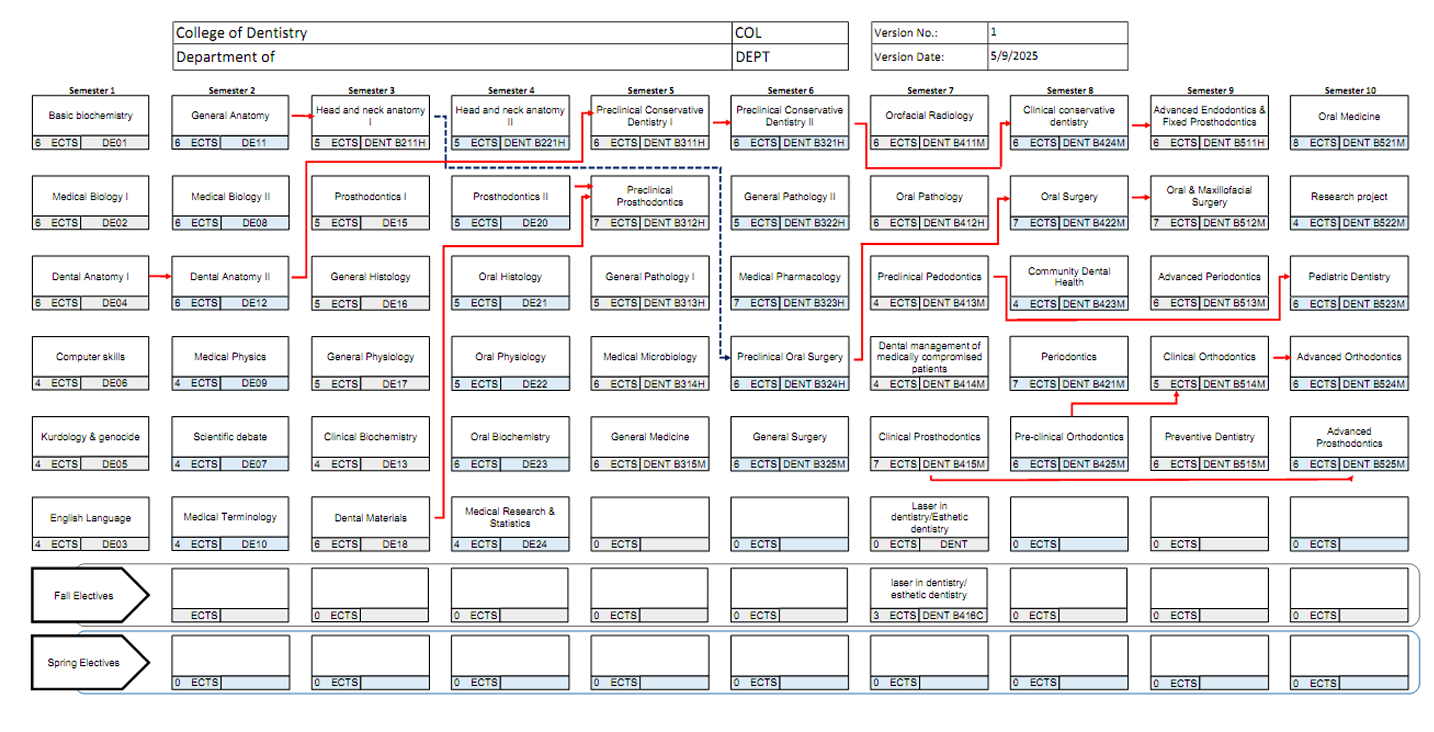
Programme structure diagram with credits
Yearly Timeline
Sept. 1, 2026
⚠️ First year students start around mid-October
⚠️ First year students start exams around 20 of January
July 1, 2027
Check out the full academic calendar on UoD's webstie.
Programme Coordinator

Lecturer in Pathology
Dental Basic Sciences
College of Dentistry
University of Duhok
Apply to the Programme
Public undergraduate admissions in the KRG region are managed centrally by the Ministry of Higher Education through the online ZankoLine portal (regayzanko.com). After Grade 12 Baccalaureate results are released, high schools provide students with unique login credentials to rank their preferred universities and B.Sc. majors during a 10–14 day registration window. Final placement is automatically determined by the student's Grade 12 average, subject choices, and department capacity.